
Die-cast Steam Locomotives by A.C. Gilbert

Model Manufacturer Info
Manufacturer:
A.C. Gilbert
Manufacturer ID:
290
Prototype Info
Category:
4-6-2
Road Name:
fantasy: American Flyer
Model Info
Gauge:
AF
Road Number:
290
Product Type:
Die-cast
Finish:
painted & lettered
Power:
AC
Couplers:
AF
Online Article:
Online Article:
Notes:
The plain or non-streamlined version. It represents the 290-series of models. These have a cast-metal body. One variation has link-and-pin style couplers, and the other variation has knuckle style couplers. All of the #29x-series locomotives share the large round feedwater heater on the top front of the boiler.
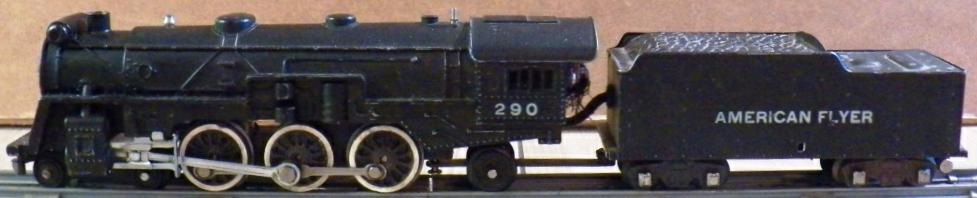
(image copyright © David Dewey; used by permission)

(image copyright © Jim Hammond; used by permission)
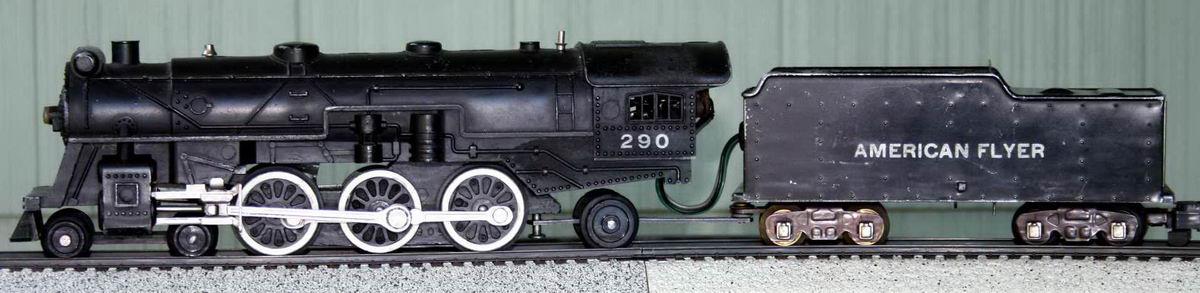
(image copyright © Jim Hammond; used by permission)
Disassembly, Motor Replacement, DCC Installation
Running on a Layout
Replacing Headling Lens, Boost Smoke
Model Manufacturer Info
Manufacturer:
A.C. Gilbert
Manufacturer ID:
295
Prototype Info
Category:
4-6-2
Road Name:
fantasy: American Flyer
Model Info
Gauge:
AF
Introduced:
1951
Road Number:
295
Product Type:
Die-cast
Finish:
painted & lettered
Power:
AC
Couplers:
AF
Online Article:

(image copyright © Jim Hammond; used by permission)
A deep dive into this rare engine.
Comparing #285 and #295
Model Manufacturer Info
Manufacturer:
A.C. Gilbert
Manufacturer ID:
314AW
Prototype Info
Category:
4-6-2
Road Name:
fantasy: American Flyer
Model Info
Gauge:
AF
Introduced:
1949
Road Number:
314AW
Product Type:
Die-cast
Finish:
painted & lettered
Power:
AC
Couplers:
AF
Notes:
This model was produced in 1949 and 1950 and was labeled for both the Pennsylvania Railroad and American Flyer. The boiler and tender were made out of diecast metal. The whistle unit is located in the tender and controlled by a separate control box (shown in the photo) with a spring-activated switch, which applies a small amount of DC current to the track that allows the whistle to blow. There are two reported variations of #314AW. The first has a one-piece trailing trucks while the second has diecast trailing trucks. Gilbert pulled the #314AW from the market for two reasons: a pending lawsuit by Lionel for patent infringement, and the whistle unit was an operational repair headache for the service stations.

(image copyright © Ted Hamler; used by permission)

(image copyright © Jim Hammond; used by permission)
Parker Sheehey testing a serviced model.
Model Manufacturer Info
Manufacturer:
A.C. Gilbert
Manufacturer ID:
353
Prototype Info
Category:
4-6-2
Road Name:
fantasy: American Flyer Circus
Model Info
Gauge:
AF
Introduced:
1950
Road Number:
353
Product Type:
Die-cast
Finish:
painted & lettered
Power:
AC
Wheels:
hi-rail
Couplers:
AF
Online Article:
Online Article:

(image copyright © Ted Hamler; used by permission)

(image copyright © Jim Hammond; used by permission)
Model Manufacturer Info
Manufacturer:
A.C. Gilbert
Manufacturer ID:
350
Prototype Info
Category:
4-6-2
Road Name:
fantasy: American Flyer Lines
Model Info
Gauge:
AF
Introduced:
1948
Road Number:
350
Product Type:
Die-cast
Finish:
painted & lettered
Power:
AC
Wheels:
hi-rail
Couplers:
AF
Online Article:
Online Article:
Notes:
This model was produced in 1948 and 1950. The streamlined B&O "Royal Blue" Pacific has a diecast boiler and sheet-metal tender. In all, there are 14 reported variations. The two 1948 models shown in the photo as well as the other eight 1948 models all have wire handrails while the 1950 models have cast handrails. Due that the fact that the Royal Blue was produced in 1940-41 as #556 as a 3/16" pre-war S-gauge locomotive that utilized three-rail track, there were some leftover tender shells from that production era. Therefore, in 1948 Gilbert used the excess tender shells on early 1948 models as seen on the #350 in the front of the photo. The indented models tend to be the rarest of the #350 except for one of the 1950 models which has "Royal Blue" printed on the tender as opposed to "American Flyer" or "American Flyer Lines" that is printed on all of the other 13 variations.

(image copyright © Jim Hammond; used by permission)

(image copyright © Jim Hammond; used by permission)

(image copyright © Jim Hammond; used by permission)

(image copyright © Ted Hamler; used by permission)
Running the Engine on a Layout
Adding Wire Handrails
Model Manufacturer Info
Manufacturer:
A.C. Gilbert
Manufacturer ID:
21045
Prototype Info
Category:
4-6-2
Road Name:
fantasy: American Flyer Lines
Class:
K5
Model Info
Gauge:
AF
Introduced:
1957
Road Number:
21045
Product Type:
Die-cast
Finish:
painted & lettered
Power:
AC
Wheels:
hi-rail
Couplers:
AF
Notes:
Dual decorated for the PRR.
Model Manufacturer Info
Manufacturer:
A.C. Gilbert
Manufacturer ID:
21084
Additional IDs:
21085
Prototype Info
Category:
4-6-2
Road Name:
fantasy: American Flyer Lines
Model Info
Gauge:
AF
Introduced:
1958
Road Number:
21084, 21085
Product Type:
Die-cast
Finish:
painted & lettered
Power:
AC
Wheels:
hi-rail
Couplers:
AF
Online Article:
Notes:
The #21085 was produced from 1958 through 1962, and, according to Greenberg, has eight listed variations. Five of the variations have the C&NW logo on the tender. The differences in these five variations include chassis design, driver material, couplers, and trucks (3 with Knuckle and 2 with Pike-Master). The three other variations reported by Greenberg are the CMStP&P versions that were all produced in 1961/62. All of which have Pike-Master trucks and couplers with the main differences being how the tender and locomotive were connected. The one variation not specifically identified in Greenberg is the CB&Q unit shown in the photo which most likely came as part of the #20813 Western 1200 produced in 1966. There are also reports that some late #21085 also has a tender marked "Reading Lines". Photo #2 has a Milwaukee Road herald on the tender. All of the electrical pickup is through the tender wheels. Photo #3 is of a very late production run of this model, where the white-wall paint on the tires has been omitted. Also, the tender is permanently riveted to the locomotive, no plug, and plastic tender trucks with a Pikemaster coupler.

(image copyright © Ted Hamler; used by permission)
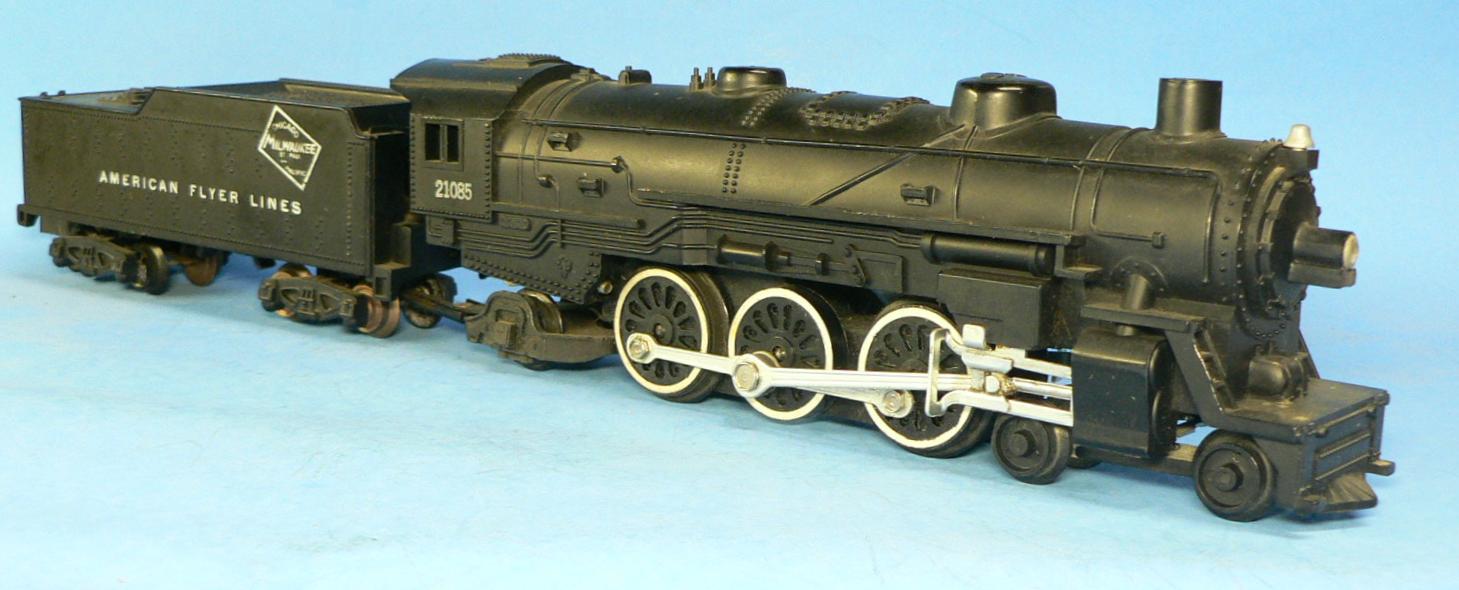
(image copyright © Ed Kirstatter; used by permission)
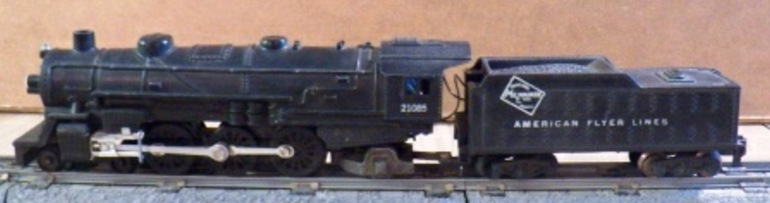
(image copyright © David Dewey; used by permission)
Repairing and cleaning a model
Model Manufacturer Info
Manufacturer:
A.C. Gilbert
Manufacturer ID:
21095
Prototype Info
Category:
4-6-2
Road Name:
fantasy: American Flyer Lines
Model Info
Gauge:
AF
Introduced:
1957
Road Number:
21095
Product Type:
Die-cast
Finish:
painted & lettered
Power:
AC
Wheels:
hi-rail
Couplers:
AF
Online Article:
Notes:
Also marked for the New York New Haven & Hartford. This may very well be the rarest A.C. Gilbert locomotive. It was shown in the 1957 catalog, but very few, if any, were ever produced and sold with "21095" on the locomotive. If one were to have bought a #21095 in 1957, the box that it came in would have been marked either "21094" or "21095" with a #293 inside. According to Greenberg, and an article that appeared in the Train Collectors Quarterly in July 1982 (pages 26-27) written by D. Robinson, the #21095 was a "replacement" body that was supplied by authorized service stations. None of the bodies have a date stamp. Photo #2 shows numbers on the inside of the shell. The "PA 10886" is the number of the die-cast Pacific body casting. The second number, on the white sticker that reads "XA10A886ERP", is Gilbert's part number for the #21095. Photo #3 shows the boxes in which the main engine and the tender came in. Because of the markings on the box, Ted Hamler and others believe that #21095 was actually sold as a complete engine by A.C. Gilbert, not as just a replacement body only.

(image copyright © Ted Hamler; used by permission)

(image copyright © Ted Hamler; used by permission)

(image copyright © Ted Hamler; used by permission)
Model Manufacturer Info
Manufacturer:
A.C. Gilbert
Manufacturer ID:
21099
Prototype Info
Category:
4-6-2
Road Name:
fantasy: American Flyer Lines
Model Info
Gauge:
AF
Introduced:
1958
Road Number:
21099
Product Type:
Die-cast
Finish:
painted & lettered
Power:
AC
Wheels:
hi-rail
Couplers:
AF
Notes:
Also marked for the New York New Haven & Hartford.

(image copyright © Ted Hamler; used by permission)
Model Manufacturer Info
Manufacturer:
A.C. Gilbert
Manufacturer ID:
310
Additional IDs:
313, 315, 316
Prototype Info
Category:
4-6-2
Road Name:
Pennsylvania Railroad (PRR)
Model Info
Gauge:
AF
Introduced:
1946
Road Number:
310, 313, 315, 316, 317
Product Type:
Die-cast
Finish:
painted & lettered
Power:
AC
Couplers:
AF
Magazine Article:
General Wiring
Online Article:
Online Article:
Online Article:
Online Article:
Online Article:
Online Article:
Supplemental Part:
Notes:
The model was produced in 1946 and 1947, and possibly 1948. It has a diecast boiler and tender. The only operating feature was its functional headlight. There are three variations of #310. The 1946 model, shown in the photo, has "Pennsylvania" printed on the tender in silver and has thin-shank link couplers. The 1947 model has "American Flyer Lines" printed in silver on the tender with the PRR logo and has thick-shank link couplers. A third model thought to have been produced in 1948 has smoke and choo-choo and looks a lot like the 1947 model except it has a brass coupler weight. See second photo for the coupler comparisons. All of the #31x-series of locomotives have the distinctive PRR Belpaire firebox (squarish section in front of the cab).

(image copyright © Ted Hamler; used by permission)

(image copyright © Ted Hamler; used by permission)
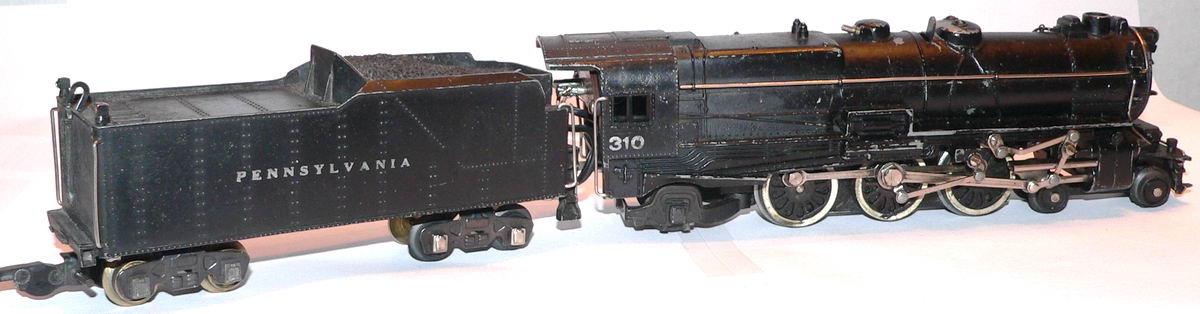
(image copyright © Jim Hammond; used by permission)
Running on Chris Monje's layout (starts at about 1:40 mark)
Model Manufacturer Info
Manufacturer:
A.C. Gilbert
Manufacturer ID:
312
Prototype Info
Category:
4-6-2
Road Name:
Pennsylvania Railroad (PRR)
Class:
K5
Model Info
Gauge:
AF
Introduced:
1946
Road Number:
312
Product Type:
Die-cast
Finish:
painted & lettered
Power:
AC
Couplers:
AF
Online Article:
Online Article:
Supplemental Part:
Notes:
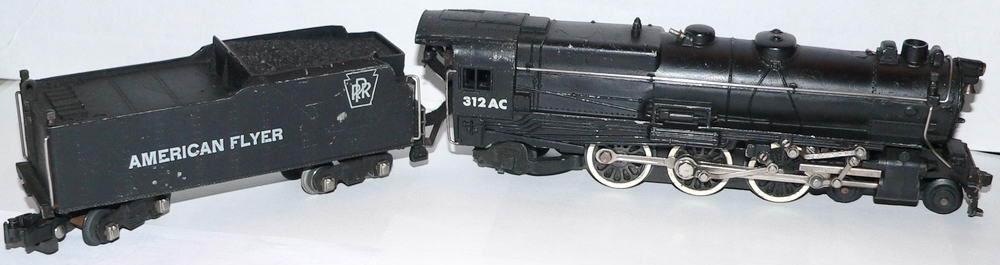
This model was produced from 1946 through 1948 and again in 1951 and 1952. It features a diecast boiler and tender. The 1946 and 1947 models have lettering on the tender in silver and are the same as they were for #310. Those models also had the smoke and choo-choo sound unit located in the tender driven by a separate motor that allowed the unit to smoke and make the choo-choo sound while sitting in the parked position. In 1948 the lettering on the tender read "American Flyer Lines" and it was in white. That model had the smoke and choo-choo sound unit moved to the boiler. By doing so, Gilbert was able to utilize the drive motor to run the smoke and choo-choo unit. Because the smoke and choo-choo unit was now in the boiler, the reverse unit was moved to the tender and as such, the smoke and choo-choo unit could not work unless the engine was moving. There are five-reported variations of #312.

(image copyright © Bill Lane; used by permission)
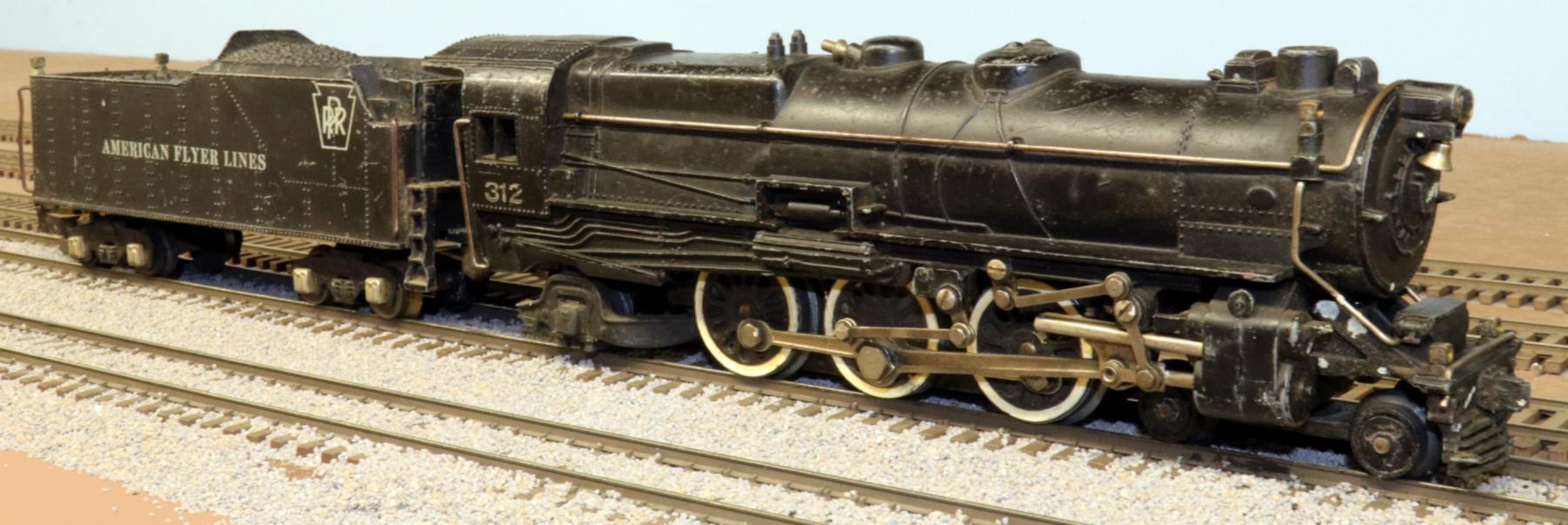
(image copyright © Bill Lane; used by permission)
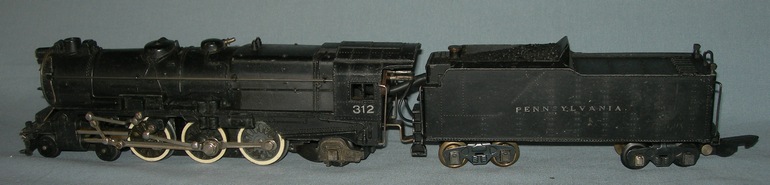
(image copyright © Ted Hamler; used by permission)
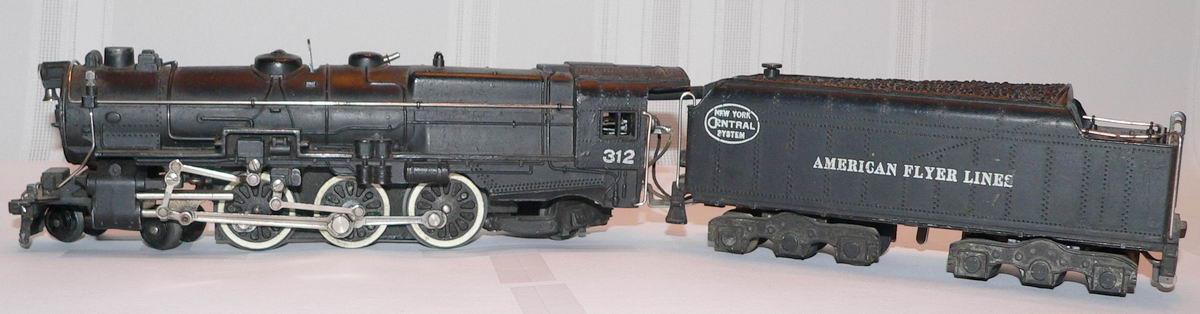
(image copyright © Jim Hammond; used by permission)
(image copyright © Jim Hammond; used by permission)
The engine running on Fred van der Lubbe's unique outdoor railroad.
Running on Chris Monje's layout, converted to scale. Starts at about the 1:20 mark.
Model Manufacturer Info
Manufacturer:
A.C. Gilbert
Manufacturer ID:
354
Prototype Info
Category:
4-6-2
Road Name:
Silver Bullet
Model Info
Gauge:
AF
Introduced:
1954
Road Number:
354
Product Type:
Die-cast
Finish:
painted & lettered
Power:
AC
Wheels:
hi-rail
Couplers:
AF
Online Article:
Online Article:
Notes:
The satin silver #354 was produced in 1954in only one variation. Unlike the #350 and #353, the locomotive body is made out of plastic while the tender is sheet metal. The #354 is equipped with knuckle couplers, an operating head light, smoke, and choo-choo.

(image copyright © Ted Hamler; used by permission)
Mike Marmer use the Soundtraxx Tsunami TSU-1000 decoder
Fred van der Lubbe running this engine on his outdoor layout
Model Manufacturer Info
Manufacturer:
A.C. Gilbert
Manufacturer ID:
356
Prototype Info
Category:
4-6-2
Road Name:
Silver Bullet
Model Info
Gauge:
AF
Introduced:
1954
Road Number:
356
Product Type:
Die-cast
Finish:
painted & lettered
Power:
AC
Wheels:
hi-rail
Couplers:
AF
Online Article:
Online Article:
Notes:
The #356 was produced in 1954 in 3 variations. The chrome of satin finish #356 is very similar to the #354 in that it has a plastic locomotive body and the tender is sheet metal. The #356 is also is equipped with an operating head light, smoke, and choo-choo. The three variations are as follows. The first has a chrome finish sheet-metal trucks and link couplers, as shown in the photo. The second has a chrome finish, Pull-Mor traction tire on the rear drivers, sintered-iron trucks, and knuckle couplers. The third, which is very rare, has a satin silver finish and link couplers.

(image copyright © Ted Hamler; used by permission)

(image copyright © Jim Hammond; used by permission)
Doing a Full Refresh of the Engine
Pulling a Passenger Train