
AF 4-6-2 Steam Locomotives

Model Manufacturer Info
Manufacturer:
A.C. Gilbert
Manufacturer ID:
290
Prototype Info
Category:
4-6-2
Road Name:
fantasy: American Flyer
Model Info
Gauge:
AF
Road Number:
290
Product Type:
Die-cast
Finish:
painted & lettered
Power:
AC
Couplers:
AF
Online Article:
Online Article:
Notes:
The plain or non-streamlined version. It represents the 290-series of models. These have a cast-metal body. One variation has link-and-pin style couplers, and the other variation has knuckle style couplers. All of the #29x-series locomotives share the large round feedwater heater on the top front of the boiler.
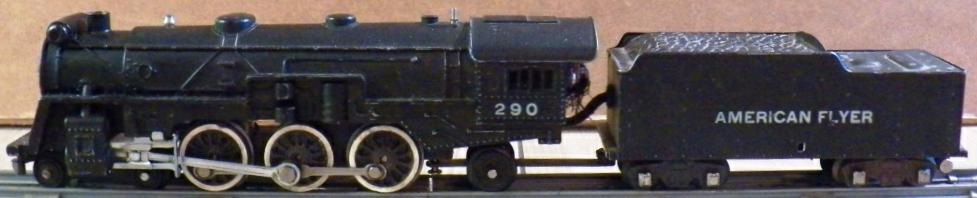
(image copyright © David Dewey; used by permission)

(image copyright © Jim Hammond; used by permission)
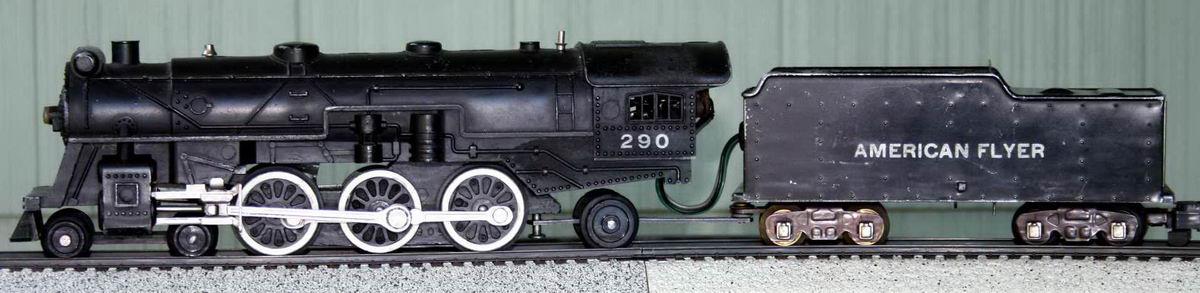
(image copyright © Jim Hammond; used by permission)
Disassembly, Motor Replacement, DCC Installation
Running on a Layout
Replacing Headling Lens, Boost Smoke
Model Manufacturer Info
Manufacturer:
A.C. Gilbert
Manufacturer ID:
295
Prototype Info
Category:
4-6-2
Road Name:
fantasy: American Flyer
Model Info
Gauge:
AF
Introduced:
1951
Road Number:
295
Product Type:
Die-cast
Finish:
painted & lettered
Power:
AC
Couplers:
AF
Online Article:

(image copyright © Jim Hammond; used by permission)
A deep dive into this rare engine.
Comparing #285 and #295
Model Manufacturer Info
Manufacturer:
A.C. Gilbert
Manufacturer ID:
299
Additional IDs:
300, 300AC
Prototype Info
Category:
4-4-2
Road Name:
fantasy: American Flyer
Model Info
Gauge:
AF
Introduced:
1946
Road Number:
299, 300
Product Type:
Die-cast
Finish:
painted & lettered
Power:
AC
Couplers:
AF
Online Article:
Online Article:
Online Article:
Online Article:
Online Article:
Online Article:
Notes:
The 1946-47 models have diecast boilers and sheet metal tenders, while the 1952 models typically have plastic boilers and tenders. There are six variations of the 1946-47 models and three variations of the 1952. The unit in the foreground of the photo is an early 1946 with an indented tender with silver lettering that read "Reading". Like the tender shell of the #350, the Atlantic tender shell was also a carryover from 1940. In 1940 tenders had separate numbers and the number for a 4-4-2 tender shell was #421. This unit, along with the next 1946 model in the photo, both have thin-shank link couplers that tended to break so in 1947 Gilbert made the shank thicker. The middle model in the photo is also a 1946 with silver letter, however it does not have the indented tender, which indicates it most likely was produced later in 1946, after most of the indented shell were used up. In the background, that model is an example of a 1947 #300 that has thick-shank coupler. However, the most notable difference is that, instead of the tender having "Reading" printed in silver on the side, the 1947 model has "American Flyer" in white letters with the reading logo. There are two reported variations of 1947 units with silver lettering like the 1946 model except they have thick-shank link couplers one of those two has an indented tender. Photo #2 is of Jack Sudimak's model converted to scale operation with the Nimco wheels replacing the Gilbert ones. Other than its scale wheels this model is pretty much in its original condition except that it has a repainted tender and a Delta type trailer truck added.

(image copyright © Jim Hammond; used by permission)

(image copyright © Ted Hamler; used by permission)

(image copyright © Ed Kirstatter; used by permission)

(image copyright © Ed Kirstatter; used by permission)
How to remove the shell (1 of 5)
Servicing the e-unit (2 of 5)
Servicing the motor (3 of 5)
Cleaning and re-assemble (4 of 5)
Final testing (5 of 5)
Repairing, Servicing This Engine
Adding Wire Handrails
Model Manufacturer Info
Manufacturer:
A.C. Gilbert
Manufacturer ID:
314AW
Prototype Info
Category:
4-6-2
Road Name:
fantasy: American Flyer
Model Info
Gauge:
AF
Introduced:
1949
Road Number:
314AW
Product Type:
Die-cast
Finish:
painted & lettered
Power:
AC
Couplers:
AF
Notes:
This model was produced in 1949 and 1950 and was labeled for both the Pennsylvania Railroad and American Flyer. The boiler and tender were made out of diecast metal. The whistle unit is located in the tender and controlled by a separate control box (shown in the photo) with a spring-activated switch, which applies a small amount of DC current to the track that allows the whistle to blow. There are two reported variations of #314AW. The first has a one-piece trailing trucks while the second has diecast trailing trucks. Gilbert pulled the #314AW from the market for two reasons: a pending lawsuit by Lionel for patent infringement, and the whistle unit was an operational repair headache for the service stations.

(image copyright © Ted Hamler; used by permission)

(image copyright © Jim Hammond; used by permission)
Parker Sheehey testing a serviced model.
Model Manufacturer Info
Manufacturer:
A.C. Gilbert
Manufacturer ID:
325
Prototype Info
Category:
4-6-4
Road Name:
fantasy: American Flyer
Model Info
Gauge:
AF
Road Number:
325
Product Type:
Die-cast
Finish:
painted & lettered
Power:
AC
Couplers:
AF
Notes:
American Flyer/NYC. Tender was made out of diecast zamac.
Getting it running again
Model Manufacturer Info
Manufacturer:
A.C. Gilbert
Manufacturer ID:
342
Prototype Info
Category:
0-8-0
Road Name:
fantasy: American Flyer
Model Info
Gauge:
AF
Introduced:
1946
Road Number:
342
Product Type:
Die-cast
Finish:
painted & lettered
Power:
AC or DC
Wheels:
hi-rail
Couplers:
AF
Online Article:
Online Article:
Online Article:
Online Article:
Notes:
#342 was produced from 1946 through 1948, and again in 1952. It has 5 variations. Three of the variations have the smoke unit located in the tender. The first of these variations, produced in 1946, has round head linkage rivets, two brass buttons, and thin shank link couplers. The second variation, produced in 1947, has hex head valve linkage rivets, no brass button on the bottom, and thick shank link coupler without a weight. The third of these units produced in 1948 is very similar to the 1947 variation except is has link couplers with a brass weight. The two remaining variations with the smoke unit housed in the boiler were produced in 1948 and 1952. The 1948 variation has hex head valve linkage rivets, no brass button on the bottom, thick shank link coupler with brass weight, and four wires running from the tender to the boiler instead of two, as was the case for the other 1948 unit with the smoke unit located in the tender. The last of the five variations, shown in the photo, was produced in December of 1952. It has white sans-serif "AMERICAN FLYER" lettering, a thick "342" road number, a "NICKEL PLATE ROAD" herald, hex head valve linkage rivets, no brass button on the bottom, thick shank link coupler with black weight, and four wire plug plus one direct wire running from the tender.

(image copyright © Ted Hamler; used by permission)
Model Manufacturer Info
Manufacturer:
A.C. Gilbert
Manufacturer ID:
K325
Prototype Info
Category:
4-6-4
Road Name:
fantasy: American Flyer
Model Info
Gauge:
AF
Introduced:
1952
Road Number:
K325
Product Type:
Die-cast
Finish:
painted & lettered
Power:
AC
Wheels:
hi-rail
Couplers:
AF
Online Article:
Notes:
The #K325 New York Central Hudson was only produced in 1952, in three variations. Shown in the main photo are two of the variations. In the foreground is the very rare early 1952 model with a knuckle coupler that is called by many as being riveted coupler. In fact, the coupler is not riveted to the truck assembly but rather the knuckle coupler is bolted to the truck assembly can be seen in Photo #2. The value of this variation is typically 2-3 times that of the other #K325 Hudsons. The second variation shown in the main photo, like the early variation, has "AMERICAN FLYER" printed on the tender along with the NYC System logo. The third variation has "AMERICAN FLYER LINES" and the NYC System logo printed on the side of the tender. Shown in Photo #2 is a close-up of both K325 Hudsons tender truck and coupler assemblies that show both styles of couplers. Tender was made out of diecast zamac.

(image copyright © Ted Hamler; used by permission)

(image copyright © Ted Hamler; used by permission)
Converting the model to use a DC can motor and a Dallee E-unit.