
Heavyweight Coach Passenger Cars by A.C. Gilbert for 1946

Prototype Info
Era:
heavyweight
Car Type:
coach
Doors:
2
Windows:
16
Road Name:
fantasy: American Flyer Lines
Road Number(s):
655
Model Manufacturer Info
Manufacturer:
A.C. Gilbert
Manufacturer ID:
655
Gauge:
AF
Introduced:
1946
Product Type:
plastic
Finish:
painted & lettered
Wheels:
hi-rail
Couplers:
AF
Lighted:
no
Online Article:
Supplemental Part:
Supplemental Part:
Notes:
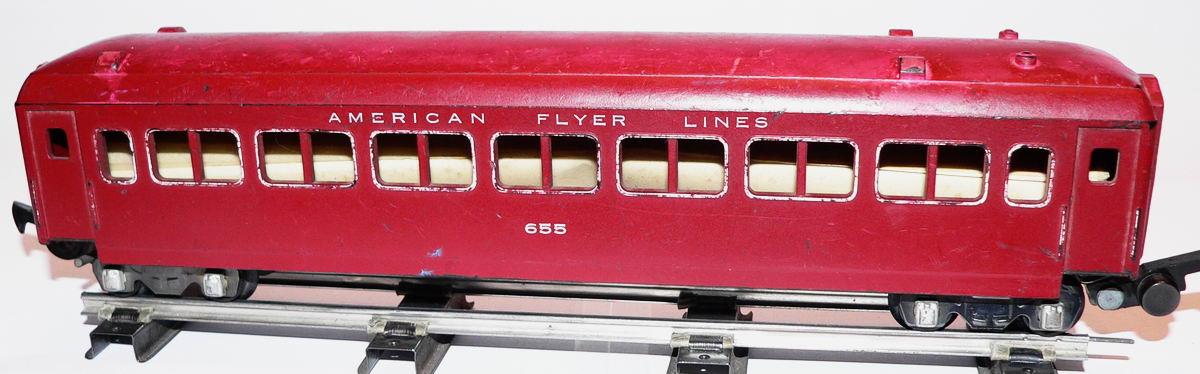
This version was available in tuscan-red/maroon and red. These cars had no steps at the bottom of the doors.
(image copyright © Jim Hammond; used by permission)
Prototype Info
Era:
heavyweight
Car Type:
coach
Doors:
2
Windows:
16
Road Name:
fantasy: American Flyer Lines
Road Number(s):
655
Car Name:
Silver Bullet
Model Manufacturer Info
Manufacturer:
A.C. Gilbert
Manufacturer ID:
655
Gauge:
AF
Introduced:
1946
Product Type:
plastic
Finish:
painted & lettered
Wheels:
hi-rail
Couplers:
AF
Lighted:
no
Online Article:
Supplemental Part:
Supplemental Part:
Notes:
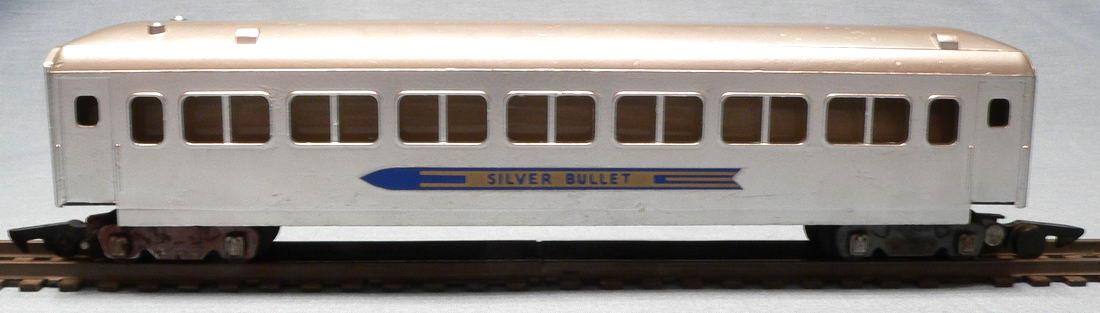
This version was available in satin finish and chrome finish . These cars had no steps at the bottom of the doors.
(image copyright © Jim Hammond; used by permission)
The car is shown with the A.C. Gilbert Window Washing accessory
Prototype Info
Era:
heavyweight
Car Type:
coach
Doors:
2
Windows:
16
Road Name:
New York, New Haven & Hartford (NH)
Road Number(s):
650
Model Manufacturer Info
Manufacturer:
A.C. Gilbert
Manufacturer ID:
650
Gauge:
AF
Introduced:
1946
Product Type:
plastic
Finish:
painted & lettered
Wheels:
hi-rail
Couplers:
AF
Lighted:
yes
Magazine Article:
S Gaugian, Jul 2001
Supplemental Part:
Notes:
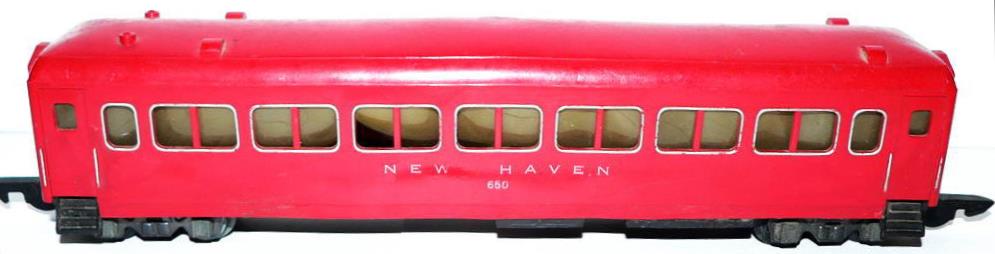
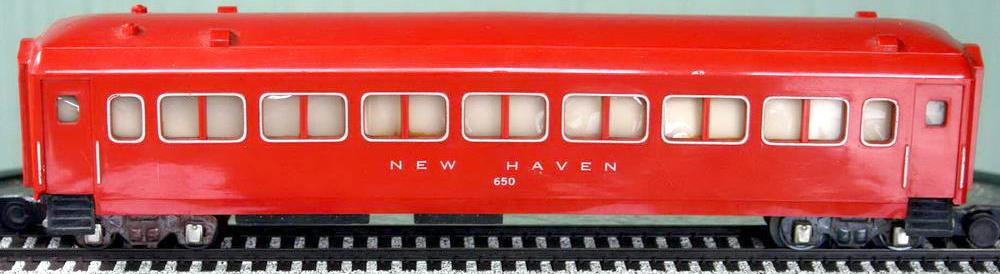
These cars were produced through 1953. They went through several generations of changes during their seven-year run. In the photo are examples of an unlighted green, and a 1946 lighted red car with silver lettering. In 1946 some materials were still in short supply, such as light assemblies, so Gilbert was forced to manufacture certain passenger cars and cabooses that were planned to be lighted as unlighted items. The box these items came in typically had the part number stamped on the end flap followed by "NL" indicating "no light" (e.g. "650NL"). Since the green passenger cars were offered as part of the lower priced sets, many of these cars came without lights, as was the case for some of the 1946 cabooses. The other issue with nearly all of the 1946 plastic cars is that they warp as can be seen in the photo. The warping was because of the new acetate plastic used at that time which was unstable. Gilbert tried to compensate or solve the warping issue by changing the frame material on the #650 cars thus creating several variations. In 1947, the red coaches were given diecast frames. Starting in 1948, the green coaches were also given the diecast frames. Starting in 1949, Gilbert also used sheet metal frames on some of the coaches of both colors.

(image copyright © Ted Hamler; used by permission)
(image copyright © Jim Hammond; used by permission)
(image copyright © Jim Hammond; used by permission)
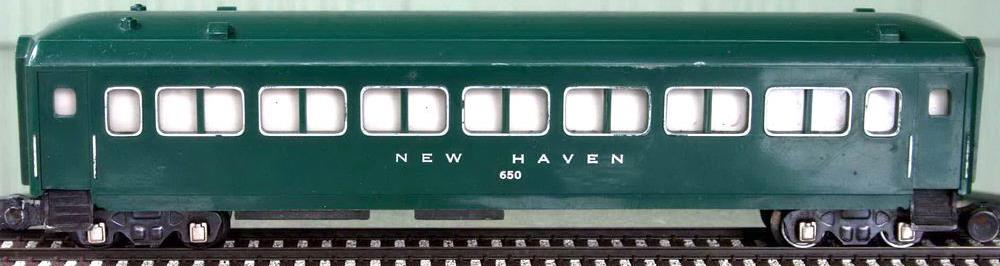
(image copyright © Jim Hammond; used by permission)
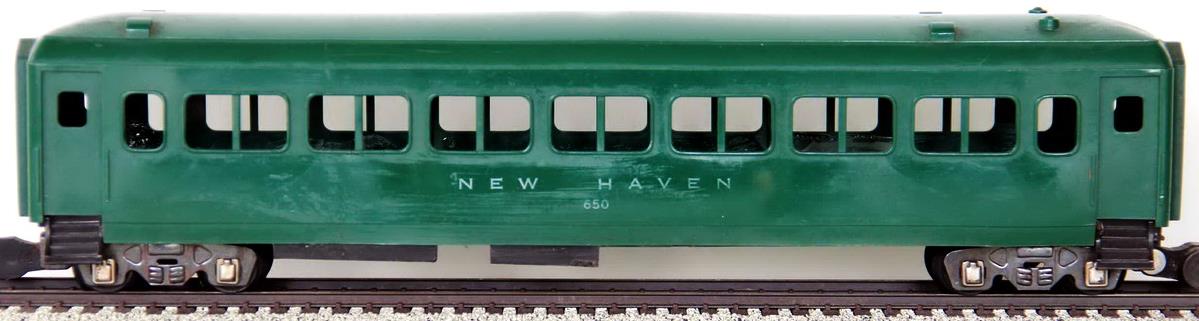
(image copyright © Jim Hammond; used by permission)
Prototype Info
Manufacturer:
Pullman
Era:
heavyweight
Car Type:
coach
Doors:
2
Windows:
12/14
Road Name:
Pullman
Road Number(s):
652
Model Manufacturer Info
Manufacturer:
A.C. Gilbert
Manufacturer ID:
652
Gauge:
AF
Introduced:
1946
Product Type:
plastic
Finish:
painted & lettered
Wheels:
hi-rail
Couplers:
AF
Lighted:
no
Supplemental Part:
Supplemental Part:
Supplemental Part:
Notes:
These models were produced through 1953, although there is some doubt whether or not they were actually produced in 1946. Of the 15 variations, the two 1947 variations are the rarest. Note that the window configurations between their two sides is different.
1947: painted green or red, 6-wheel trucks that are 2-1/2" long with thick shank link couplers.
1948: painted green or red, 6-wheel trucks that are 2-1/8" long with couplers that have brass weights.
1948 (late): unpainted green plastic and two variations with unpainted tuscan plastic; the latter has one variation with the number on the ends of the side, and the other with the number in the center.
1949: from now on all came with link couplers with blackened weights; painted green; number in the center.
1949-1952: two variations have olive-green and two variations of unpainted (molded) tuscan plastic bodies with short trucks, with centered numbers (the lettering style was different between the two for each body color).
1953: the wording was changed to show "Pikes Peak" above the windows and "American Flyers Lines" below the windows, and "Pullman" was moved to the end of the car; there were two tuscan variations (two different lettering styles for "Pullman") and one green one.

(image copyright © Ted Hamler; used by permission)

(image copyright © Ron Kemp; used by permission)

(image copyright © Ted Hamler; used by permission)
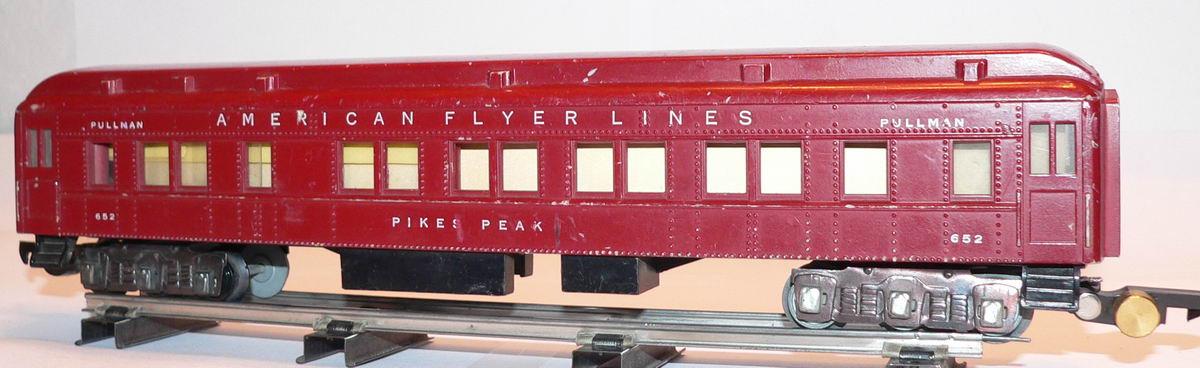
(image copyright © Jim Hammond; used by permission)