NASG
Store
News
Events
Clubs

Wabash Valley Lines, Inc. F7: Lehigh Valley (LV)

Model Manufacturer Info

Manufacturer:

Wabash Valley Lines, Inc.

Manufacturer ID:

772.2-64-112

Prototype Info

Category:

F7

Year/Era:

1949

Manufacturer:

Electro-Motive Division (EMD)

Dimensions:

50'8"

Road Name:

Lehigh Valley (LV)

Ext. Reference:

Ext. Reference:

Ext. Reference:

Model Info

Gauge:

S

Introduced:

1985

Product Type:

Resin

Finish:

unpainted

Power:

No Chassis

Supplemental Part:

Notes:

The Wabash Valley shells are an improved version of the Enhorning F-unit casts (the Enhorning ones had a deformation on their roof top and a crease on the side). Compared to prototype photos, the Wabash Valley Models shells represent F3 phase IV (9/1948 to 2/1949) EMD bodies. The shell has the slight "V"-shape above the rear end flat door panel, which is consistent with F3 body ends, but there is no roof overhang. The shell has the two rectangular roof vents for the dynamic brakes which are an F3 phase IV feature. Some shell modifications would need to be made by the modeler to represent a true F7. Originally, the recommendation was to use an American Models FP7 chassis to power these models. However, the American Models GP9 (which was not available back then) is a much better fit and will only require some corner trimming of the GP9's metal base. Also, the trucks line up better with the shell. Additional details, such as simulated glass and couplers will need to be added by the modeler for a complete model.
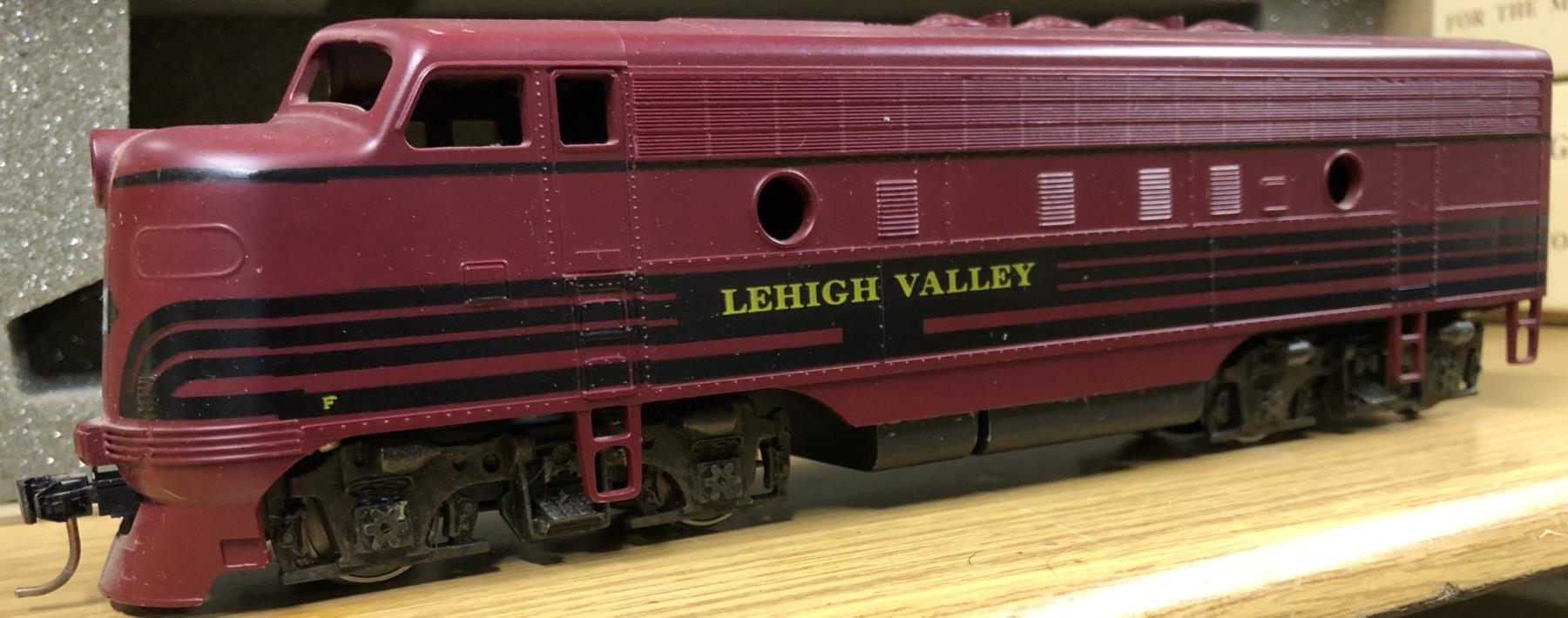

 (image copyright © John Henning; used by permission)
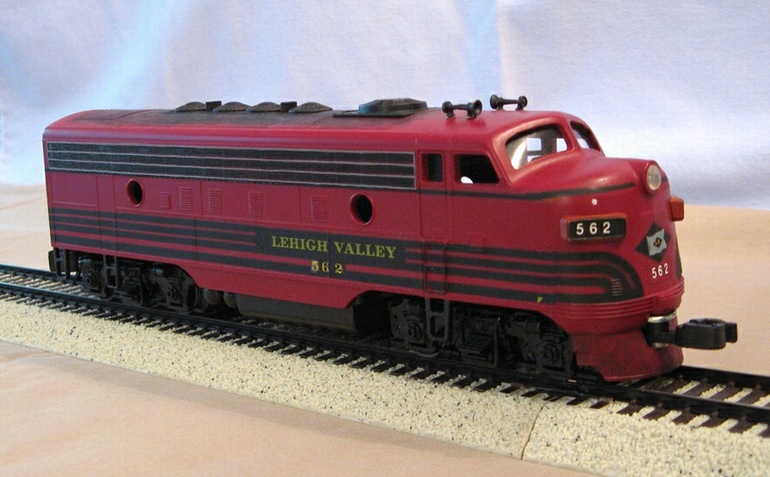
Model was owned by Jack Sudimak.

 (image copyright © Holt Apgar; used by permission)
Holt Apger added a scale 4'-diameter fan on roof for dynamic brakes, air horns and number boards from B.T.S., and a motor drive and gears unit from an American Models GP9. The AM GP9 drive unit base is 8-3/4" long, and is a good fit for the F7A shell with minor corner trimming of the aluminum alloy drive base; the "recommended" AM FP7 drive unit base, at 9-3/4", is too long, and does not match up with the cutaways on the F7A shell for the drive trucks (those recommendations were made before the AM GP9 chassis was available at the time). He also trimmed the width of the metal drive base by about 1/16" with dremel and file for a snug fit; no screws used. The black paint for the Farr air grills and rooftop exhaust is Testors Model Master enamel, brushed by hand. Light gray enamel was used for the fine trim around the Farr air grills. Road numbers are from miscellaneous decals he had on hand, as well as Woodland Scenics dry transfers. He used flexible clear acrylic sheet for the window and door glazing (side windows are left open for airflow). The long coupler tabs on the AM drive unit were cut back in length and then re-drilled and tapped for the AM 2-56 pivoting coupler screws; note the smaller fixed AM coupler in front, and an operating AM hi-rail coupler has been mounted on the rear end. The roof top and front pilot weathering was brushed-on thinned Model Master flat black enamel, to give the model a mid-1950s road-worn appearance. The Lehigh Valley RR acquired 8 F7A diesels from GM/EMD in 1950, even numbers from 560 thru 574; the odd numbers were F7B units. The prototype 562 engine ran freight on the LV from 1950 until a 1972 trade-in.

 (image copyright © Wabash Valley Lines, Inc.)
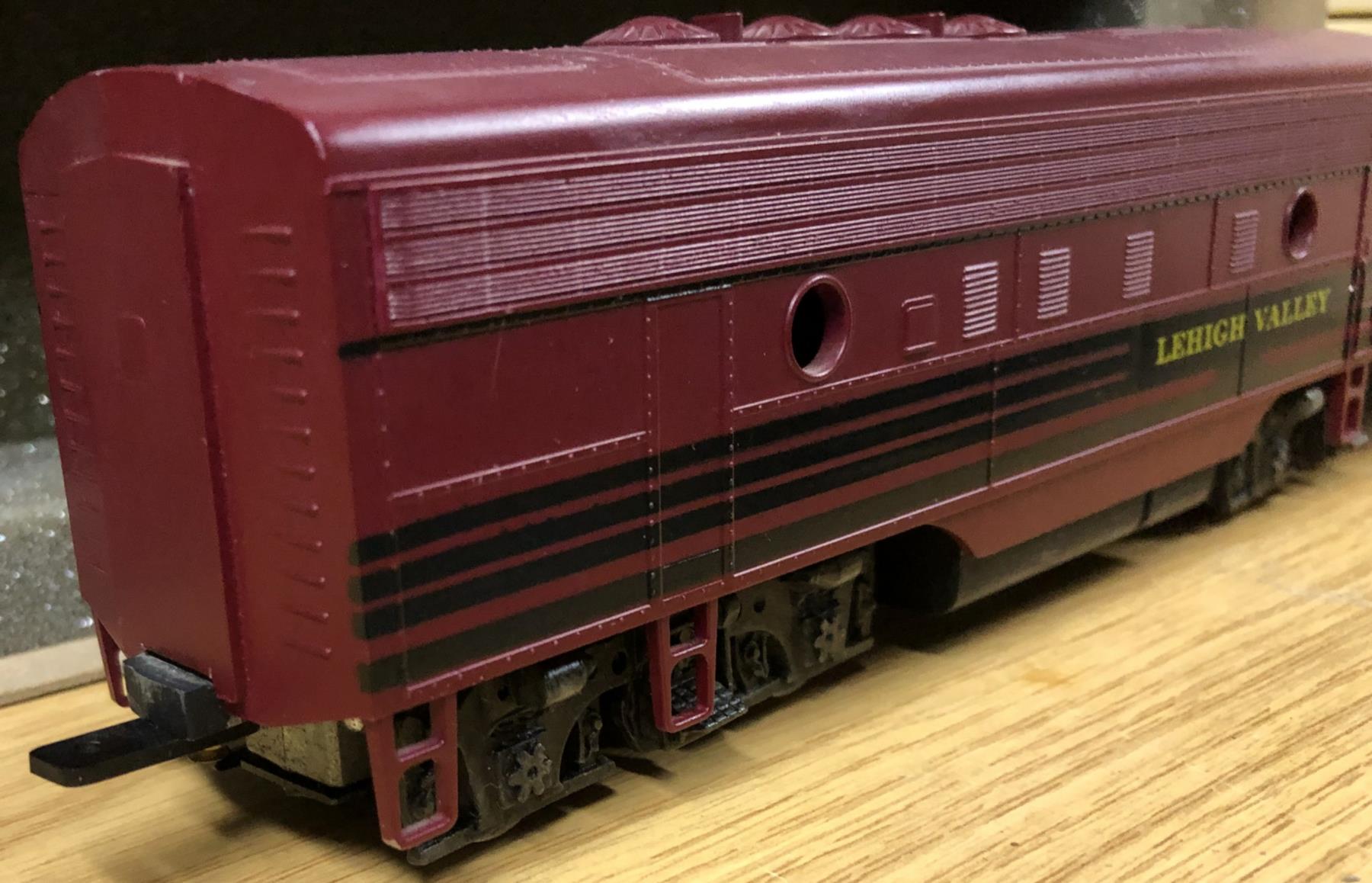
A manufacturer's photo of the available shells.

(image copyright © John Henning; used by permission)
Layouts
Product Gallery
How-to
Resources
Site