
A.C. Gilbert AF Center-cupola Cabooses

Model Manufacturer Info
Prototype Info
Style:
center-cupola
Body:
steel
Road Name:
fantasy: American Flyer
Model Info
Gauge:
AF
Introduced:
1949
Road Number(s):
638
Product Type:
plastic
Finish:
painted & lettered
Wheels:
hi-rail
Couplers:
AF
Product Notes:
Notes:
The #638 was produced from 1949 through 1952 in five red plastic and five red painted variations with the road name "AMERICAN FLYER". In 1953, the #638 was produced with the road name "AMERICAN FLYER LINES" in four variations. In the front row of the photo is an example of the red plastic model from 1949-52. The one on the left in the back row is a painted variation produced in 1949-52. The caboose on the right is an example of the version produced in 1953. Of the 14 variation, most of the differences in variations have to do with lettering style and body types. The 638 is very similar to 630, except for the road name.

(image copyright © Ted Hamler; used by permission)

(image copyright © Jim Hammond; used by permission)

(image copyright © A.C. Gilbert)
Install LED Lighting
Running on a Layout
Model Manufacturer Info
Prototype Info
Style:
center-cupola
Body:
steel
Road Name:
fantasy: American Flyer
Model Info
Gauge:
AF
Introduced:
1952
Road Number(s):
930
Product Type:
plastic
Finish:
painted & lettered
Wheels:
hi-rail
Couplers:
AF
Lighted:
yes!
Weight:
Raoul started the company in 1959. He retired in 2008. Dave Rygmyr bought the company and moved it to Hamilton, Montana. Dave retired in 2019, and NWSL employees Holly and Ian bought the company and moved it to Kila, Montana.

(image copyright © Ted Hamler; used by permission)

(image copyright © Ted Hamler; used by permission)

(image copyright © Ted Hamler; used by permission)

(image copyright © Holt Apgar; used by permission)

(image copyright © A.C. Gilbert)

(image copyright © Jim Hammond; used by permission)
Repair and Upgrade
Model Manufacturer Info
Prototype Info
Style:
center-cupola
Body:
steel
Road Name:
fantasy: American Flyer Lines
Model Info
Gauge:
AF
Introduced:
1956
Road Number(s):
806
Product Type:
plastic
Finish:
painted & lettered
Wheels:
hi-rail
Couplers:
AF
Notes:
The 800 series cars were not sold separately, but rather were part of three lower-priced catalog sets in 1956-57 and were part of a few uncataloged sets. This model has two variations, where one has 1/8" lettering while the second has 5/32" lettering.
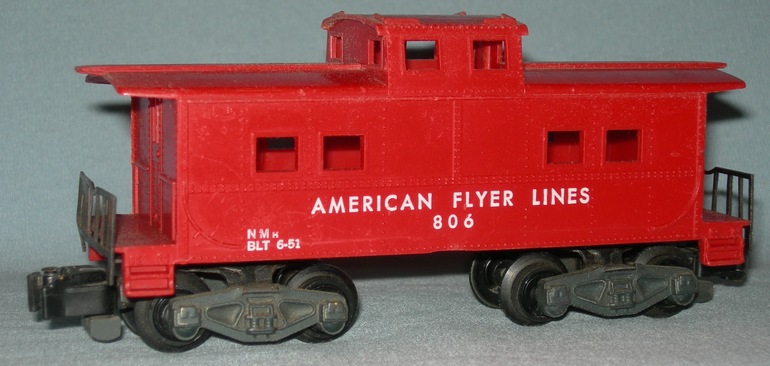
(image copyright © Ted Hamler; used by permission)
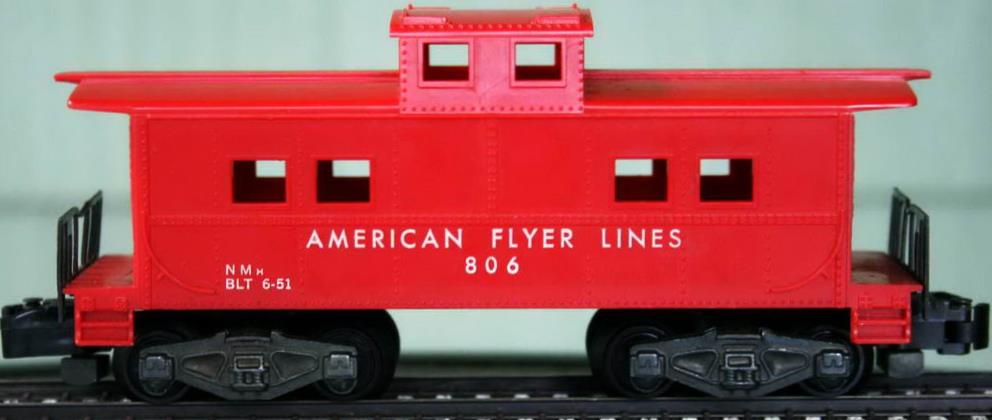
(image copyright © Jim Hammond; used by permission)
Model Manufacturer Info
Prototype Info
Style:
center-cupola
Body:
steel
Road Name:
fantasy: American Flyer Lines
Model Info
Gauge:
AF
Introduced:
1956
Road Number(s):
904
Product Type:
plastic
Finish:
painted & lettered
Wheels:
hi-rail
Couplers:
AF

(image copyright © Jim Hammond; used by permission)
Model Manufacturer Info
Prototype Info
Style:
center-cupola
Body:
steel
Road Name:
fantasy: American Flyer Lines
Model Info
Gauge:
AF
Introduced:
1954
Road Number(s):
934
Product Type:
plastic
Finish:
painted & lettered
Wheels:
hi-rail
Couplers:
AF
Notes:
This was an uncataloged item. Since the 934 was assigned to a floodlight series of cars in 1953, noted author and historian Ted Hamler believes a mistake was made when assigning a number to the caboose as two different items were not to carry the same catalog number. The 934 caboose is identical to the 938 caboose that was also introduced in 1954, however the 938 was a bobtail style (single-coupler) caboose whereas the 934 has a coupler on both ends.

(image copyright © Ted Hamler; used by permission)

(image copyright © Holt Apgar; used by permission)

(image copyright © Holt Apgar; used by permission)
Model Manufacturer Info
Prototype Info
Style:
center-cupola
Body:
steel
Road Name:
fantasy: American Flyer Lines
Model Info
Gauge:
AF
Introduced:
1954
Road Number(s):
91524
Product Type:
plastic
Finish:
painted & lettered
Wheels:
hi-rail
Couplers:
AF
Notes:
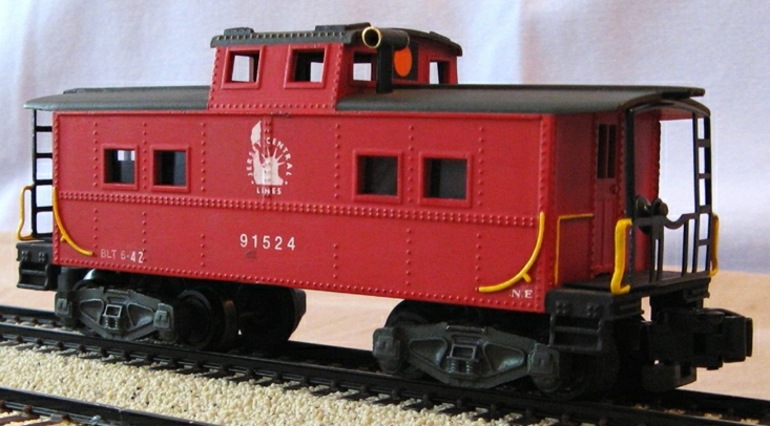
The #938 was produced in 1954 and 1955 in three variations. The first variation, shown in the first photo, is painted red over a Type I or a Type II black plastic body that is a bobtail style caboose (no rear coupler) with Type 8 trucks. The second with a straight-sided "M" is painted red over a Type I black plastic body with Type 8A. The third variation is painted red over either a black or a white Type II body that is mounted on Type 7 trucks. The 938 was basically a 638 renumbered due to the switch to knuckle couplers.
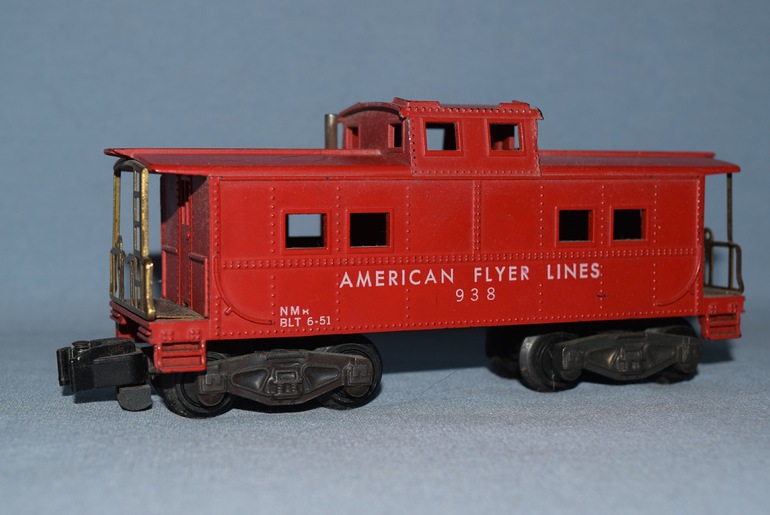
(image copyright © Ted Hamler; used by permission)
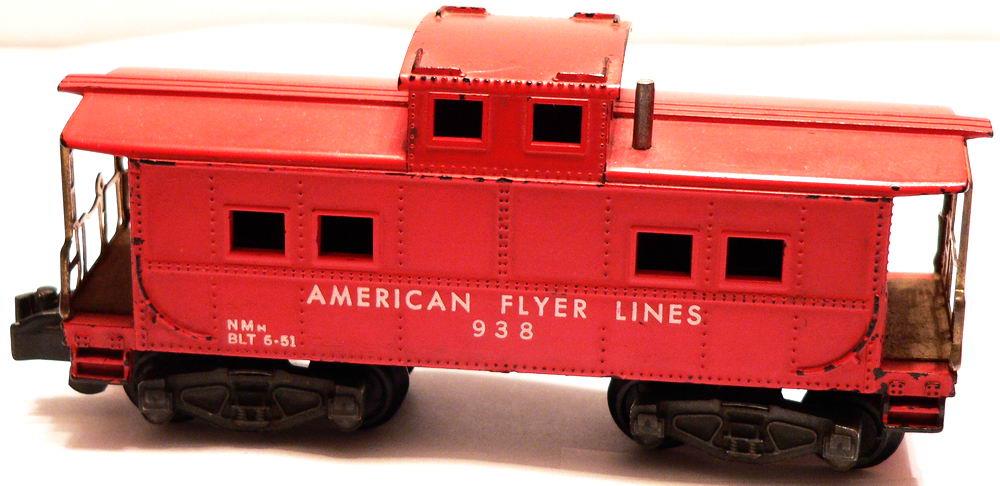
(image copyright © Jim Hammond; used by permission)
(image copyright © Holt Apgar; used by permission)
(image copyright © Holt Apgar; used by permission)
Model Manufacturer Info
Prototype Info
Style:
center-cupola
Body:
steel
Road Name:
fantasy: American Flyer Lines
Model Info
Gauge:
AF
Introduced:
1955
Road Number(s):
977
Product Type:
plastic
Finish:
painted & lettered
Wheels:
hi-rail
Couplers:
AF
Lighted:
yes!

(image copyright © Ted Hamler; used by permission)

(image copyright © Jim Hammond; used by permission)

(image copyright © A.C. Gilbert)
Install Full-wave Bridge Rectifier
Install Full-wave Bridge Rectifier Demo
Model Manufacturer Info
Prototype Info
Style:
center-cupola
Body:
steel
Road Name:
fantasy: American Flyer Lines
Model Info
Gauge:
AF
Introduced:
1957
Road Number(s):
24603
Product Type:
plastic
Finish:
painted & lettered
Wheels:
hi-rail
Couplers:
AF
Notes:
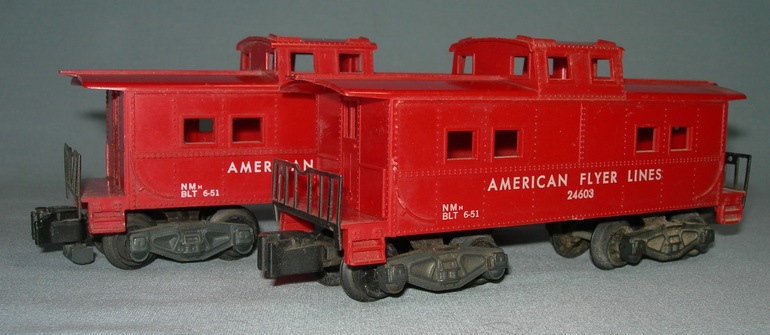
The #24603 was illustrated in both the 1957 and 1958 catalogs. The #24603 was only produced in 1958 as very few cars were actually produced with a 5-digit number on the car in 1957. The #24603 has two variations as shown in the photos. One has solid non-operating knuckle couplers while the second has standard operating knuckle couplers.
(image copyright © Ted Hamler; used by permission)
Model Manufacturer Info
Prototype Info
Style:
center-cupola
Body:
steel
Road Name:
fantasy: American Flyer Lines
Model Info
Gauge:
AF
Introduced:
1958
Road Number(s):
24610
Product Type:
plastic
Finish:
painted & lettered
Wheels:
hi-rail
Couplers:
AF
Online Article:
(image copyright © Ted Hamler; used by permission)
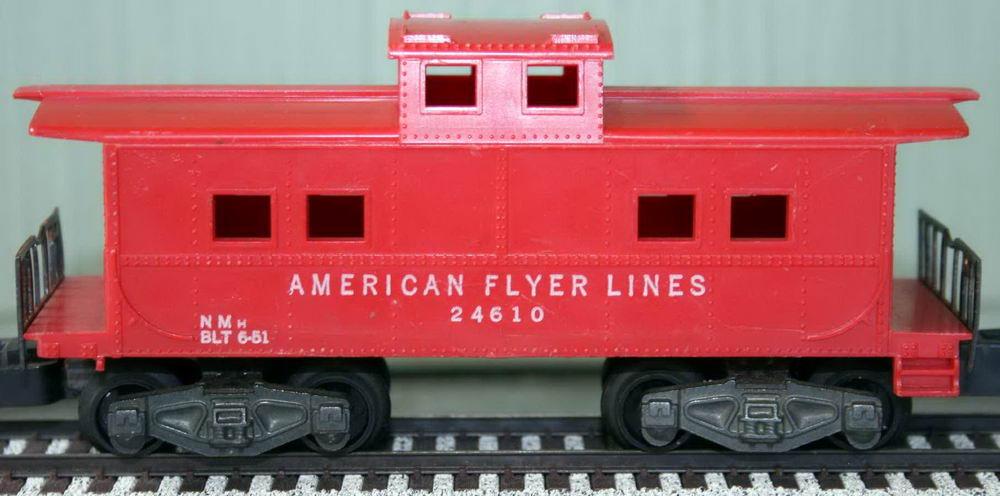
(image copyright © Jim Hammond; used by permission)
Model Manufacturer Info
Prototype Info
Style:
center-cupola
Body:
steel
Road Name:
fantasy: American Flyer Lines
Model Info
Gauge:
AF
Introduced:
1958
Road Number(s):
24626
Product Type:
plastic
Finish:
painted & lettered
Wheels:
hi-rail
Couplers:
AF
Product Notes:
Notes:
The #24626 was produced in 1958 in three variations. The first variation is shown in the photo which has a red-orange stripe, grab irons, and no window coverings. The second is identical except it has window coverings. The third has maroon stripe and grab irons.
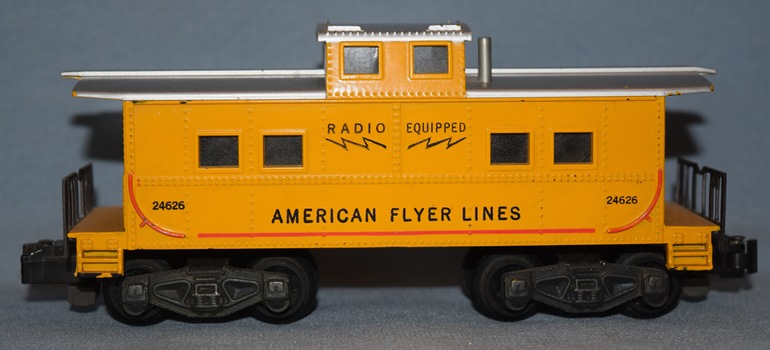
(image copyright © Ted Hamler; used by permission)
Model Manufacturer Info
Prototype Info
Style:
center-cupola
Body:
steel
Road Name:
fantasy: American Flyer Lines
Model Info
Gauge:
AF
Introduced:
1959
Road Number(s):
24627
Product Type:
plastic
Finish:
painted & lettered
Wheels:
hi-rail
Couplers:
AF
Notes:
The bobtail (only one coupler) #24627 was produced in 1959 and 1960 in two variations. The first variation, shown in the photo, has a red unpainted plastic body. The second variation is painted red over a red plastic body.
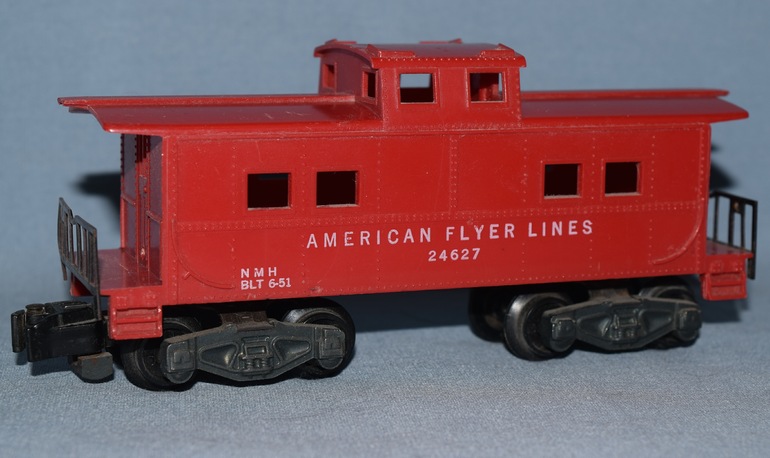
(image copyright © Ted Hamler; used by permission)
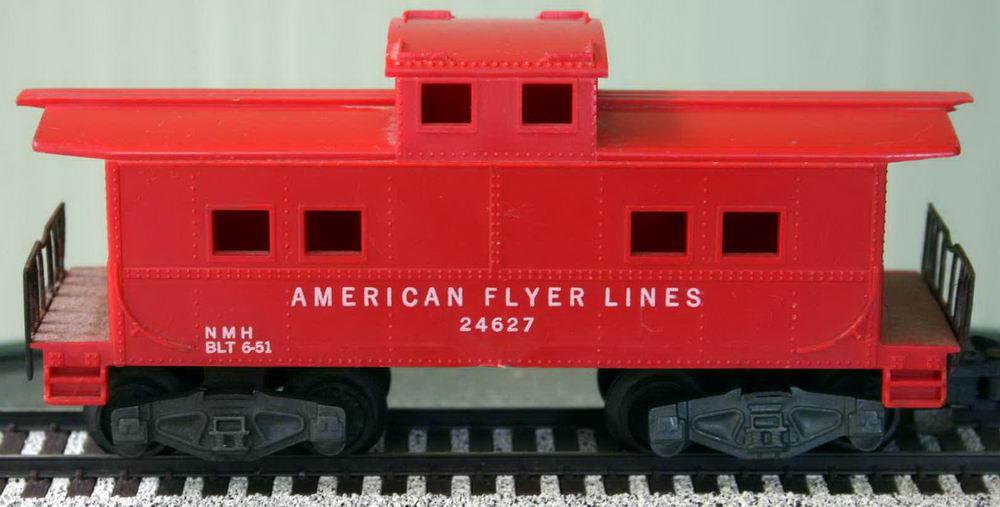
(image copyright © Jim Hammond; used by permission)
Model Manufacturer Info
Prototype Info
Style:
center-cupola
Body:
steel
Road Name:
fantasy: American Flyer Lines
Model Info
Gauge:
AF
Introduced:
1960
Road Number(s):
24630
Product Type:
plastic
Finish:
painted & lettered
Wheels:
hi-rail
Couplers:
AF
Notes:
Bobtail caboose (only one coupler). The model in the photo has solid non-operating knuckle coupler. Because Gilbert offered the car in 1961 in uncataloged sets, it did not come with Pike-Master couplers and trucks like many other cataloged 1961 cars.

(image copyright © Ted Hamler; used by permission)
Model Manufacturer Info
Prototype Info
Style:
center-cupola
Body:
steel
Road Name:
fantasy: American Flyer Lines
Model Info
Gauge:
AF
Introduced:
1959
Road Number(s):
24631
Product Type:
plastic
Finish:
painted & lettered
Wheels:
hi-rail
Couplers:
AF
Notes:
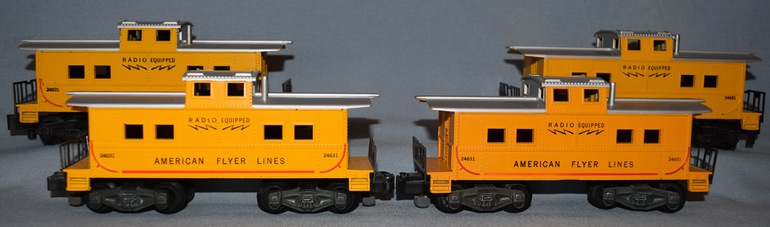
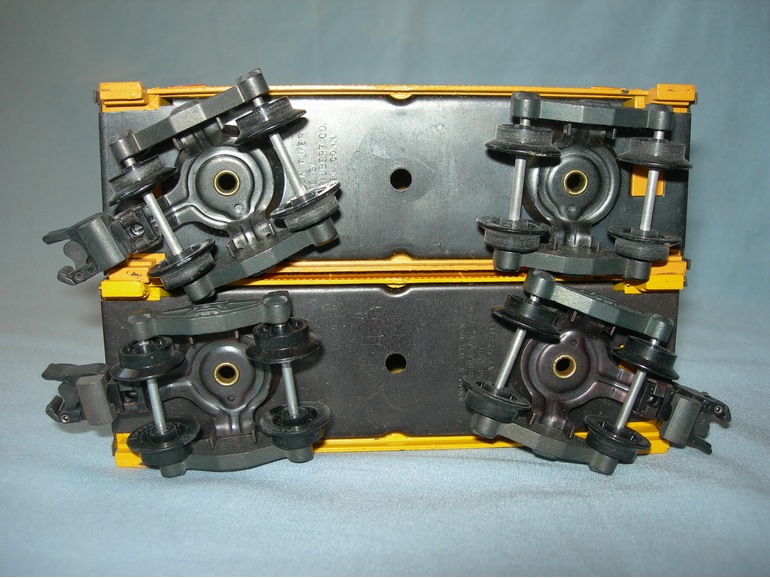
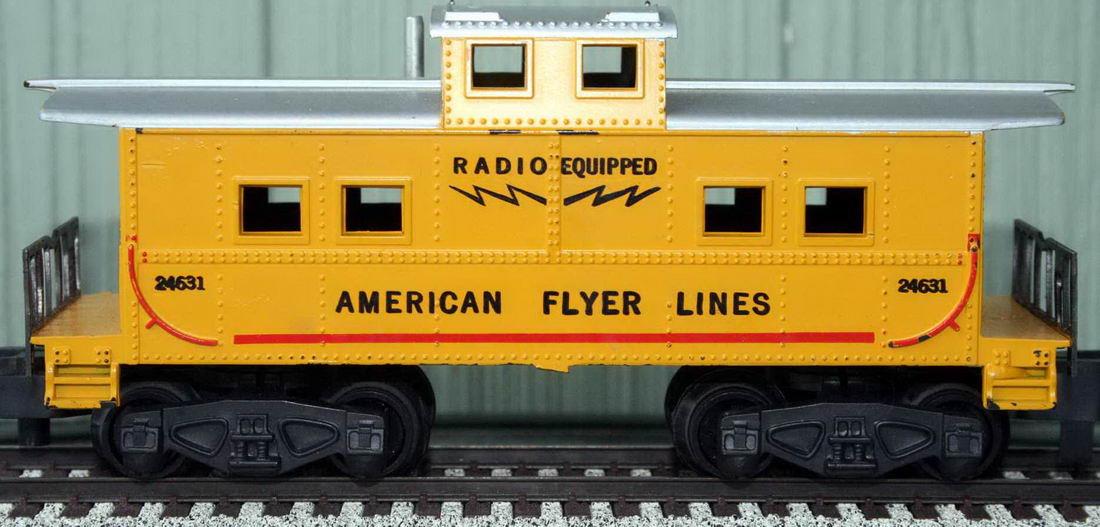
The #24631 was produced twice. The first time was from 1959 through 1961 in three variations. The second time from 1963 through 1965 in four variations. In the front row of the first photo are examples of two of the three 1959-61 cabooses with knuckle couplers. On the left is the first variation, which has flat yellow finish, red-orange stripe, and grabs irons. The second variation on the right is similar to the first except it is a bobtail style caboose meaning it has just one coupler (see Photo #2 for the underside view which shows this clearly). The third variation of the 1959-61 group has a shiny yellow finish with red-orange stripe and grabs irons instead of the red-orange as on the two previous cabooses. In the back row of the first photo are two examples of the four variations of the 1963-65 Pike-Master #24631 cabooses. On the left is the first variation, which has red-orange strip and grab irons. The second variation, shown in the back row on the right, while it has grab irons they are not painted and the caboose also lacks the red-orange stripe. The third and fourth variation both have maroon painted grab irons and stripes. The third variation has both of the top steps on one end filled in (The step being filled in is a result of an older mold). The fourth variation does not have the steps filled in.
(image copyright © Ted Hamler; used by permission)
(image copyright © Ted Hamler; used by permission)
(image copyright © Jim Hammond; used by permission)
(image copyright © A.C. Gilbert)
Model Manufacturer Info
Manufacturer:
A.C. Gilbert
Manufacturer ID:
24632
Prototype Info
Style:
center-cupola
Body:
steel
Road Name:
fantasy: American Flyer Lines
Model Info
Gauge:
AF
Introduced:
1959
Road Number(s):
24632
Product Type:
plastic
Finish:
painted & lettered
Wheels:
hi-rail
Couplers:
AF
Notes:
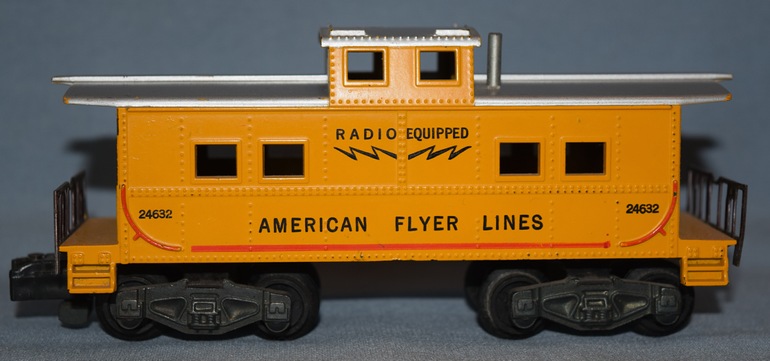
The #24632 was produced in only one reported variation. It is a bobtail style of caboose (only one coupler).
(image copyright © Ted Hamler; used by permission)
Model Manufacturer Info
Prototype Info
Style:
center-cupola
Body:
steel
Road Name:
fantasy: American Flyer Lines
Model Info
Gauge:
AF
Introduced:
1961
Road Number(s):
24636
Product Type:
plastic
Finish:
painted & lettered
Wheels:
hi-rail
Couplers:
AF
Notes:
The #24636 was produced from 1961 through 1966 in 14 variations. The 14 variations all exist within six major groupings, four of which the caboose is unpainted red plastic while the two remaining groups have painted cabooses. The first grouping has lettering on the cabooses that is 1/8" high. The group has four variations, the main differences with the cabooses in this group have to do with the steps being filled in or not. In Photo #3, the caboose in the front row is an example of one of the four variations. The second major grouping has one variation with lettering that is 5/32" high. The third grouping, which has two variations, has lettering that is 3/16" high. The difference in the two variations within this group is that one is marked "RADIO EQUIPPED" while the second is not so marked. Both of the variations are shown in the back row of Photo #3. The fourth major grouping has three variations. All of the cabooses in this group have lettering that is 7/32" high. The first variation in this group the caboose is marked "RADIO EQUIPPED", while the second and third variation within this group are not so marked. The differences in these two is that the "M" in the word "AMERICAN" on one of the variations is pointed on top while the "M" on the other variation is flat-topped. See the two cabooses in the back row of Photo #3 as an example of the two different styles of the letter "M". The two remaining grouping are #24636 AFL cabooses which are painted. The source of red painted caboose is uncertain (see the first photo); some experts believe they came from the 20811 set. In the declining years, which started as early as 1961, Gilbert would paint cars to cover up defects in the cars, as the molds grew older. Photo #2 is of the yellow caboose, which was uncataloged. Its exact source is also unknown. It has been reported as being part of some of the 1966 20811 "The Pioneer" 600 sets. The first grouping is of the red painted #24636 that has one variation. The second grouping, which consisted on yellow painted #24636, has three variations. The three variations are a result of the number of steps that are filled in.

(image copyright © Ted Hamler; used by permission)

(image copyright © Ted Hamler; used by permission)

(image copyright © Ted Hamler; used by permission)

(image copyright © Jim Hammond; used by permission)
Model Manufacturer Info
Manufacturer:
A.C. Gilbert
Manufacturer ID:
25031
Prototype Info
Style:
center-cupola
Body:
steel
Road Name:
fantasy: American Flyer Lines
Model Info
Gauge:
AF
Introduced:
1958
Road Number(s):
25031
Product Type:
plastic
Finish:
painted & lettered
Wheels:
hi-rail
Couplers:
AF
Notes:
This action caboose is one of the rarest of all post-war cabooses. The reason being that it was not sold separately even though it was listed in the 1958 catalog. In 1958 Gilbert had an abundance of 977 cabooses and sold them in sets and as separate sale items. The only known source for the 25031 Action Caboose was part a very limited number of 1958 Meteor sets as reported by Dennis Bagby in Greenberg's Guide to American Flyer S Gauge Volume III Sets, First Edition. The 1958 set with an action caboose was advertised as having 25031, however, nearly all sets contained the 977 caboose.

(image copyright © Ted Hamler; used by permission)
Model Manufacturer Info
Manufacturer:
A.C. Gilbert
Prototype Info
Style:
center-cupola
Body:
steel
Road Name:
fantasy: Freight Ahead
Model Info
Gauge:
AF
Introduced:
1963
Product Type:
plastic
Finish:
painted & lettered
Wheels:
hi-rail
Couplers:
AF
Notes:
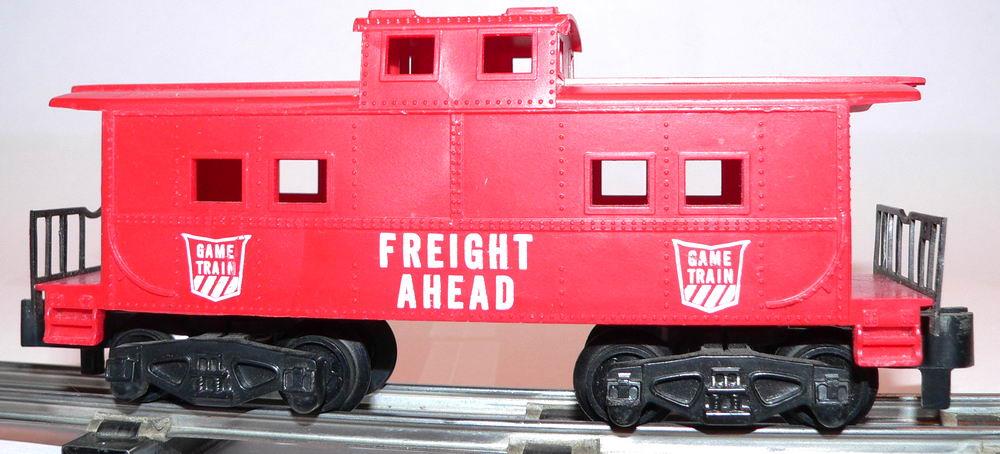
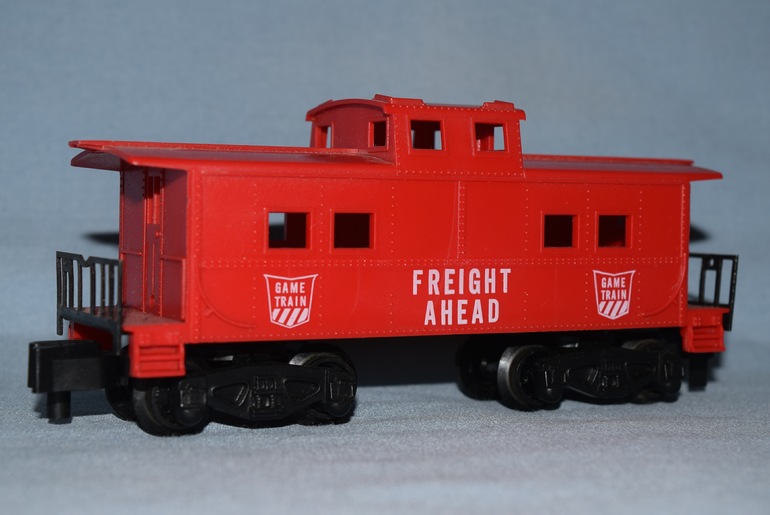
The 1963 Freight Ahead caboose has two variations. One variation utilizes a Type B frame while the second variation utilizes a Type D frame. The Buffalo Hunt Gondola and the Freight Ahead caboose are the only two cars produced by Gilbert that did not have a catalog number. This unusual caboose was not sold separately and was offered only as part of the 1963 #20800 Game Train set.
(image copyright © Jim Hammond; used by permission)
(image copyright © Ted Hamler; used by permission)
Model Manufacturer Info
Prototype Info
Style:
center-cupola
Body:
steel
Road Name:
Reading (RDG)
Model Info
Gauge:
AF
Introduced:
1946
Road Number(s):
630
Product Type:
plastic
Finish:
painted & lettered
Wheels:
hi-rail
Couplers:
AF
Lighted:
yes!
Product Notes:
Notes:
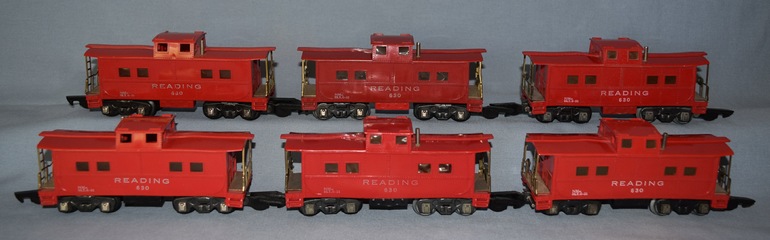
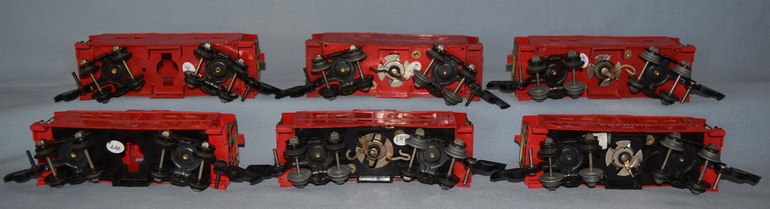
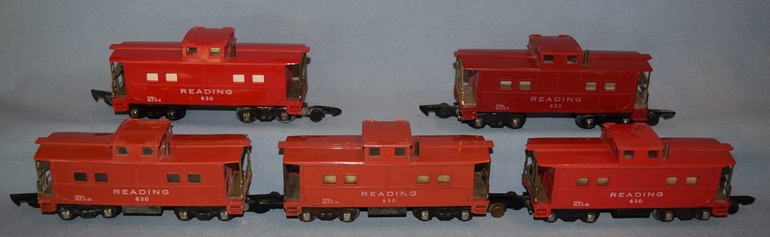
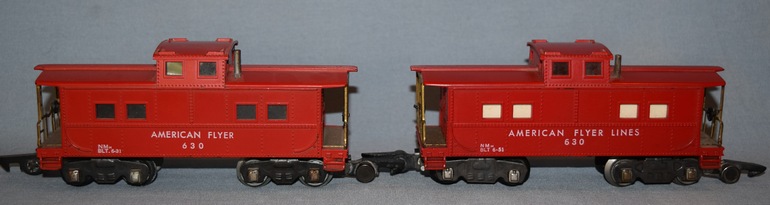
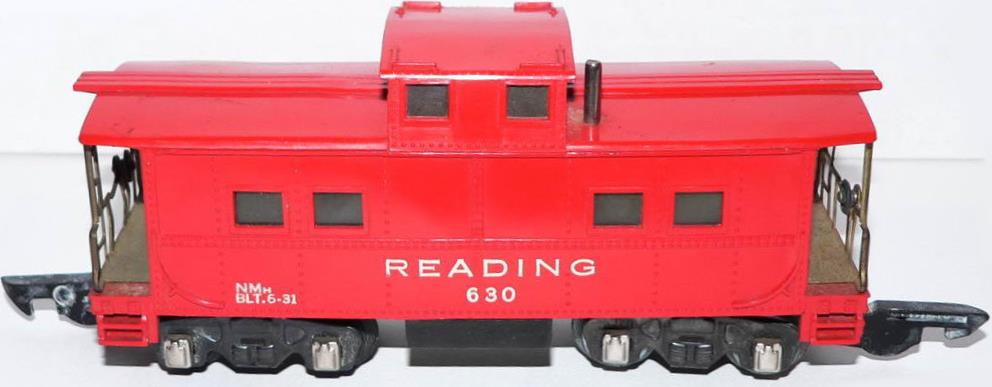
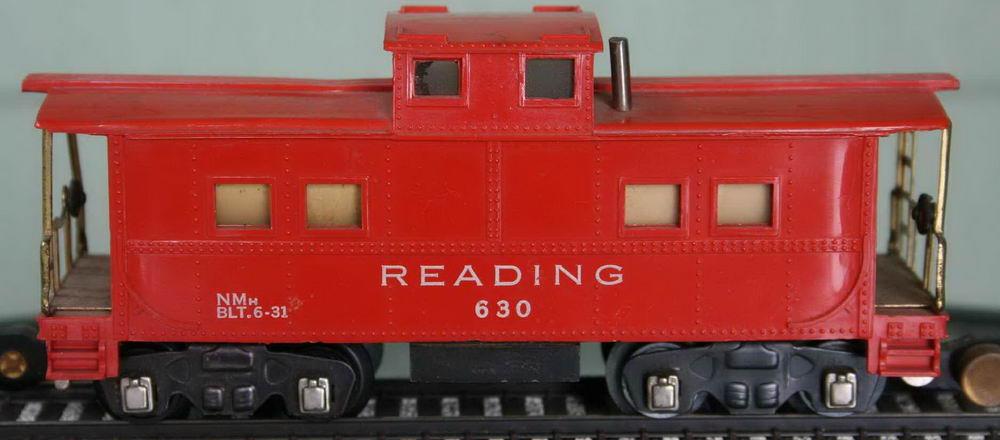
The #630 was produced from 1946 until 1953 in 26 variations. Many of the variations have to do with the style of lettering and window coverings. There are, however, four major variation groupings. The first variation grouping has seven variations, which were produced in 1946. They carried the "READING" name, and the the frame was either red or black plastic. Due to material shortages, early 1946 cabooses that were part of lower priced sets, came without a light and had silver lettering. Later in 1946, both the red and black frame models had lights and silver lettering and finally the lettering was changed from silver to white. The second major variation grouping has nine variations with the "READING" name. These were produced in 1947, 1948, and 1950. All of these cabooses have a diecast metal frame to eliminate the wrapping that occurred with all of the 1946 plastic frame cabooses. The front row of Photo #3 shows examples of those models. In 1949, Gilbert created the third major variation again based upon the frame type. In 1949, 1951, and 1952 the "READING" cabooses all had sheet metal frames to reduce cost and weight of the cabooses. This grouping has three variations. Two of the variations within the group have red plastic bodies, while the third has a red painted body. The last major grouping produced in 1952 and 1953 has seven variations. In that grouping, all of the frames are sheet metal and none of the cabooses carried the "READING" name. In 1952 the one variation carried the "AMERICAN FLYER" name while in 1953 the six variations all carried the "AMERICAN FLYER LINES" name, as can be seen in the fourth photo.
(image copyright © Ted Hamler; used by permission)
(image copyright © Ted Hamler; used by permission)
(image copyright © Ted Hamler; used by permission)
(image copyright © Ted Hamler; used by permission)
(image copyright © A.C. Gilbert)
(image copyright © Bob Werre; used by permission)
(image copyright © Jim Hammond; used by permission)
(image copyright © Jim Hammond; used by permission)
Minimize Interior Light Flicker
Clean-up and Maintenance
Running on a Layout